
10 Music Listening Activities That Spark Middle School Discussions

10 Ways to Turn Music Listening Worksheets into Engaging Classroom Discussions
Simple, low-prep music listening activities and teaching strategies to develop active listening, musical vocabulary and critical thinking in middle school music.
Music listening worksheets are a valuable tool in the middle school music classroom. They help students focus on the elements of music, organise their observations and develop the vocabulary needed to describe what they hear.
But what happens after students complete their worksheets?
Rather than simply checking answers and moving on to the next activity, why not use those responses as the starting point for an engaging classroom discussion?
A few carefully chosen questions can transform a straightforward music listening activity into an opportunity for students to share ideas, compare interpretations, justify opinions and develop a deeper understanding of music.
The best part? You don't need additional worksheets, special equipment or a completely new lesson plan. These ten simple teaching strategies can be used with music listening activities you already have.
Whether you're exploring classical music, rock, pop, jazz or film music, these ideas will help your middle school and junior high school students become more thoughtful, confident listeners.
But what happens after students complete their worksheets?
1. Think – Pair – Share
Give every student time to think before joining the discussion.
Think – Pair – Share encourages participation in middle school music listening activities, particularly among students reluctant to speak in front of the class.
After listening to a musical excerpt:
-
Think: Students independently answer one or two questions on their music listening worksheet.
-
Pair: Partners compare responses and explain their choices rather than simply checking whether their answers match.
-
Share: Pairs share an interesting observation, a difference of opinion or something new they discovered.
Try asking:
-
Which element of music stood out most clearly to you?
-
Did you and your partner describe the mood in the same way?
-
What musical evidence supports your answer?
-
What did your partner notice that you hadn't considered?
Teaching Tip: Allow 30–60 seconds for independent thinking. Support students with sentence starters such as "I noticed…" or "I think… because…".
Why it works: Students organise their thoughts and practise musical vocabulary with a partner before contributing to a whole-class discussion. They also discover that listeners may notice different musical features in the same piece.
2. What Did You Hear? Exploring the Elements of Music
Encourage students to support their listening observations with musical evidence.
Music listening worksheets often ask students to identify elements of music such as tempo, dynamics, rhythm, texture and instrumentation. But can students explain how they recognised those elements?
Turn these questions into musical discussions by asking students to explain the evidence behind their answers.
For example, if a student describes the dynamics as loud, ask whether the music remained loud throughout or changed. Did it begin quietly and gradually become louder (crescendo), or suddenly change from loud to soft?
Replay a short excerpt and encourage students to identify the musical features that support their observations.
Try asking:
-
What did you hear that helped you identify the tempo?
-
Which instruments can you recognise, and what clues helped you identify them?
-
How do the dynamics change throughout the excerpt?
-
Does the musical texture become thicker or thinner?
-
Which rhythmic or melodic patterns can you recognise?
Teaching Tip: Encourage students to move beyond one-word answers. Instead of fast, they might explain, "The music has a fast tempo, with a steady beat and quick rhythmic patterns." Support students with a musical vocabulary word bank or sentence starters such as "I noticed…" and "I could tell because…".
Why it works: Students connect musical terminology with the sounds they hear. Structured activities, such as Elements of Music concept maps and listening analysis worksheets, help students organise their observations and describe musical features. Explaining their answers strengthens active listening skills, musical vocabulary and confidence.
3. Agree or Disagree? A Music Listening Discussion Challenge
Turn music listening worksheets into opportunities for critical thinking and musical debate.
A little friendly debate encourages middle school students to listen carefully and think critically about what they hear.
After completing their listening worksheets, present a statement about the music and ask students whether they agree or disagree. The statement may be correct, incorrect or open to interpretation, but students must support their responses with musical evidence.
For example:
"The music becomes more dramatic because the tempo increases."
Students may initially agree because the music sounds more exciting. However, listening again might reveal that the tempo remains steady while the dynamics increase or additional instruments enter, creating a thicker texture.
This opens a discussion about how different musical elements contribute to the overall effect.
Try these statements:
-
"The percussion instruments provide the strongest rhythmic patterns."
-
"The dynamics remain the same throughout the excerpt."
-
"The music sounds cheerful because it has a fast tempo."
-
"The texture becomes thicker towards the end."
-
"The melody is more important than the accompaniment in creating the mood."
Ask students to explain their choices before replaying the relevant section.
Teaching Tip: Use thumbs-up for agree, thumbs-down for disagree or a sideways thumb for not sure. Alternatively, let students discuss their opinions with a partner before sharing. Occasionally include statements combining accurate and inaccurate observations to encourage careful listening rather than guessing.
Why it works: Students learn to evaluate musical claims, recognise relationships between musical elements and support their opinions with evidence. They also practise expressing different viewpoints and listening respectfully to others.
4. One Song, Different Opinions: Exploring Mood in Music
Discover how the same music can create different emotional responses.
Two students can hear the same piece of music and experience very different emotions. One might describe an excerpt as mysterious, while another hears it as peaceful or even unsettling.
These differences provide a starting point for discussions about mood, expression and the elements of music.
After completing a music listening worksheet, ask students to choose three words describing the mood or character of the music. Have them compare their choices with a partner or small group, explaining which musical features influenced their interpretations.
For example, one student might describe a piece as tense because of its dissonant harmonies and sudden dynamic changes. Another might hear it as exciting because of its driving rhythm and energetic instrumentation.
Both interpretations can lead to meaningful discussions when students explain what they heard.
Try asking:
-
Which three words best describe the mood or character of this music?
-
What musical features influenced your choices?
-
Did your classmates describe the music differently?
-
How might the tempo, dynamics or instrumentation affect the mood?
-
Does the mood change during the excerpt? What causes that change?
Teaching Tip: Create a class mood word bank using terms such as dramatic, reflective, energetic, tense, playful, mysterious, peaceful and triumphant. Ask students to share their strongest mood word, record the responses on the board and discuss common choices or surprising differences. Encourage students to support their selections with musical evidence.
Why it works: Students expand their descriptive vocabulary and develop confidence in expressing musical opinions. They discover that different interpretations can be reasonable when supported by evidence and deepen their understanding of how musical elements influence mood.
5. Become the Music Detective: An Active Listening Challenge
Turn repeated listening into an investigation that encourages students to notice musical details.
Give students a specific purpose for listening by turning them into music detectives who create clues for their classmates to investigate.
After completing a music listening worksheet, students select an interesting observation, such as a sudden dynamic change, a new instrument entering, a repeated melody or an unusual rhythmic pattern.
They then turn their observation into a detective clue.
For example:
"Listen carefully for the moment when a new instrument joins the melody. Can you identify the instrument?"
Replay the excerpt and ask classmates to identify the musical feature, explain what they heard and, where possible, indicate approximately when it occurred.
Try these music detective challenges:
-
Find the moment when the dynamics change suddenly.
-
Identify an instrument that enters after the opening section.
-
Listen for a repeated rhythmic or melodic pattern.
-
Find a section where the musical texture becomes thicker or thinner.
-
Identify a change in tempo or articulation.
-
Listen for a musical phrase that returns later in the piece.
Teaching Tip: Encourage clues based on musical evidence rather than personal opinions. Genre identification activities, such as Match the Music Genres – Set 1, can also help students listen for distinctive rhythms, instruments and vocal styles, then explain what gave the genre away.
Why it works: Creating and investigating musical clues encourages focused listening and helps students notice details they might otherwise overlook. Students also practise musical vocabulary and communicate their observations clearly.
6. The One-Minute Music Debate: Defend Your Musical Opinion
Encourage students to support their musical opinions with evidence and consider different viewpoints.
A short, structured debate brings energy to middle school music listening activities without taking up much lesson time.
After students complete their listening worksheets, choose a question with more than one reasonable answer.
For example:
"Which element of music contributes most to the mood of this piece?"
One student might argue that dynamics have the greatest impact, while another considers instrumentation or rhythm more important. The challenge is to explain why, using musical evidence.
How to Run a One-Minute Music Debate
- Choose a question. Select a question based on the music students have heard.
- Prepare an opinion. Allow 30 seconds for students to review their worksheets and identify supporting evidence.
- Present the arguments. Invite two or three students to share different viewpoints, allowing up to one minute per contribution.
- Listen and reconsider. Replay a short excerpt and ask whether the arguments changed anyone's thinking.
Try debating:
- Which element of music has the greatest impact on the mood?
- Are dynamics or tempo more important in creating excitement?
- Which instrument contributes most to the overall sound?
- Which section of the music is most effective, and why?
- Would the music communicate the same mood without percussion?
- Does the melody or accompaniment create more musical interest?
Teaching Tip: Model the difference between personal preference and musical evidence.
Instead of "I think the drums are most important because I like them," encourage:
"I think the percussion has the greatest impact because the repeated rhythmic pattern creates tension and drives the music forward."
For reluctant speakers, begin with partner debates, allowing each student 30 seconds to present their opinion before discussing the supporting evidence.
Set the Ground Rules
Introduce one simple rule:
"You can disagree with an opinion, but you must explain your musical reasoning."
Keep discussions respectful and focused on the music. The aim isn't to declare a winner but to explore different interpretations.
Remember: The complete activity takes approximately 3–5 minutes. The one-minute limit applies to each student's contribution, not the entire debate.
Why it works: Short debates develop critical thinking, musical reasoning and communication skills. Students learn to justify their opinions with evidence while considering different interpretations respectfully
7. Listen Again – Did You Change Your Mind?
Encourage students to reconsider their observations and discover musical details they may have missed.
Repeated listening helps middle school students recognise musical patterns, focus on different elements of music and develop a deeper understanding of what they hear.
First impressions aren't always accurate, and that's perfectly fine!
For example, a student might initially describe a piece as slow, then realise the tempo is moderate but the melody contains long note values. Another might recognise additional instrumental layers during a second listening.
How to Use This Strategy
After completing their music listening worksheets, ask students to choose one answer they'd like to reconsider.
Replay the excerpt, encouraging them to focus on that particular musical element. Students then confirm or revise their original responses and explain what they heard differently.
Try asking:
- What did you notice during the second listening that you missed the first time?
- Did any of your original answers change? Why?
- Which musical element became clearer when you listened again?
- What musical evidence helped you confirm or revise your answer?
- Did your classmates' observations influence what you listened for?
Teaching Tip: Use two different coloured pens or pencils: one for original observations and another for new discoveries or revised answers. This creates a visual record of students' developing listening skills.
You can also assign a different purpose to each listening:
- First listening: Identify the overall mood, tempo and instrumentation.
- Second listening: Focus on changes in dynamics, texture or musical structure.
- Third listening (optional): Investigate a feature identified during the class discussion.
Why it works: Repeated listening strengthens students' ability to recognise musical details and make accurate observations. It also encourages reflection and shows that reconsidering an answer is a valuable part of learning.
8. Same or Different?
Use comparison to sharpen students' listening skills.
Comparing two musical excerpts is an effective way to help students recognise musical characteristics.
Choose two contrasting pieces, or two different performances or arrangements of the same piece.
Students listen to each excerpt and record observations about tempo, dynamics, instrumentation, texture, rhythm and mood.
Next, ask them to identify similarities and differences.
This approach works particularly well when exploring musical genres, styles and historical periods.
Try asking:
- Which musical elements are similar in both excerpts?
- How does the instrumentation differ?
- Which excerpt has a stronger rhythmic emphasis?
- How do the two pieces create different moods?
- Which musical features help you identify the genre or style?
Teaching Tip: For a quick discussion, focus on just two elements, such as rhythm and instrumentation. Students can complete a simple comparison table or Venn diagram before sharing their observations.
Why it works: Comparison encourages students to listen analytically and recognise the characteristics that distinguish different styles, performances and arrangements.
9. Students Become the Question Makers: Student-Led Music Listening Discussions
Encourage students to take ownership of their learning by creating thoughtful questions about the music they hear.
Instead of answering only teacher-provided questions, invite students to create their own music listening questions.
After completing a worksheet, students write one question that encourages classmates to investigate a musical feature, compare observations or consider a different interpretation.
The aim is to move beyond simple factual questions towards prompts that encourage explanation and discussion.
For example, instead of asking:
"Is the music loud or soft?"
Students might ask:
"How do changes in dynamics affect the mood of the music?"
This encourages deeper listening and musical reasoning rather than a one-word answer.
How to Use This Strategy
- Listen and reflect. Students complete a listening worksheet and identify an interesting musical feature.
- Create a question. Each student writes one open-ended question about the music.
- Share and refine. Partners exchange questions and suggest improvements.
- Lead the discussion. Students ask their questions in small groups or as a class.
- Return to the music. Replay relevant excerpts so students can investigate questions and support their answers with musical evidence.
Encourage questions that begin with:
- How does…? How does the instrumentation contribute to the mood?
- Why might…? Why might the composer introduce a new instrument here?
- What changes when…? What changes when the percussion enters?
- Which musical element…? Which element creates the strongest sense of tension?
- What evidence suggests…? What evidence suggests the music is approaching a climax?
- How would the music change if…? How would the character change at a slower tempo?
Teaching Tip: Model how to transform simple questions into thoughtful discussion prompts. Provide question starters for students needing support.
For a quick variation, collect student-generated questions in a container and select several at random for a whole-class discussion.
Why it works: Creating questions develops students' critical thinking, musical vocabulary and ability to recognise relationships between musical elements. It also builds confidence and gives students greater ownership of classroom discussions.
10. Prove It with the Music! Support Your Musical Opinions with Evidence
Challenge students to explain their musical observations and identify the sounds that support their thinking.
Students can easily describe music as exciting, dramatic or mysterious. The challenge is explaining what they heard that led them to that conclusion.
After completing a music listening worksheet, ask students to select an observation or opinion and support it with specific musical evidence.
For example:
"The musical texture becomes thicker towards the end of the piece."
Ask students how they know. They might identify additional instruments entering, new rhythmic layers or a more complex accompaniment. Replay the relevant excerpt so classmates can evaluate the evidence.
How to Use This Strategy
Introduce a three-step approach:
-
Make a claim. Select an observation or opinion from the listening worksheet.
-
Find the evidence. Identify a musical feature or passage that supports the claim.
-
Explain the connection. Describe how the evidence supports the original statement.
For example:
-
Claim: "The music becomes more dramatic towards the end."
-
Evidence: "The dynamics increase, the percussion becomes more prominent and additional instruments enter."
-
Explanation: "These changes create a fuller, more powerful sound that increases the sense of excitement and drama."
Try these musical claims:
-
"The dynamics increase as the music approaches the climax."
-
"The melody is repeated with a different accompaniment."
-
"The percussion creates a sense of excitement."
-
"The instrumentation changes between the two sections."
-
"The music becomes more tense before the final section."
-
"The composer uses contrast to create musical interest."
Students can investigate one of these claims or create their own using observations from their worksheets.
Teaching Tip: Use Sentence Starters
Support students with:
"I think ______ because I can hear ______."
For example:
"I think the music becomes more exciting because I can hear the percussion getting louder and the rhythmic patterns becoming more active."
For more confident students, extend the response:
"At approximately ______, the music changes because ______, which creates ______."
For example:
"At approximately 1 minute 20 seconds, additional instruments enter and the dynamics increase, creating a more dramatic and powerful sound."
Encourage approximate timestamps to help the class locate and revisit specific musical passages.
An Optional Classroom Challenge
Invite a student to make a musical claim without revealing their evidence.
For example:
"The mood changes dramatically halfway through the piece."
Replay the excerpt and challenge classmates to identify evidence supporting or challenging the claim. Compare observations and discuss whether the musical evidence is convincing.
Why it works: Students develop analytical listening skills, apply musical vocabulary and learn to justify their observations. They also discover that while musical interpretations may differ, thoughtful opinions should be supported by what can actually be heard.
Helping Reluctant Students Join Music Listening Discussions
Not every middle school student feels comfortable sharing musical observations with classmates. Some lack confidence using musical vocabulary, while others worry about giving the wrong answer.
Here are five ways to encourage participation:
-
Allow thinking time. Give students a minute to organise their thoughts or write an observation before speaking.
-
Start with partners. Let students discuss their answers with a partner or small group before sharing with the class.
-
Provide sentence starters. Phrases such as "I noticed…", "I think… because…" and "I agree with… because…" help students express their ideas.
-
Offer different ways to respond. Students can write, contribute to a shared word bank or participate in a small-group discussion. An Elements of Music Graffiti Board also provides a collaborative way to share observations and build musical vocabulary.
-
Encourage thoughtful contributions. Acknowledge students who explain their reasoning, even when their interpretations differ from those of classmates.
Teaching Tip: Remind students that music listening doesn't always have one correct answer. Musical features can often be identified objectively, but interpretations of mood and expression may differ.
The goal is to build confidence, encourage respectful discussion and help students support their observations with musical evidence.
A Simple Five-Minute Music Listening Discussion Routine
You don't need an entire lesson for musical discussion. Just five minutes after completing a music listening worksheet can help students practise musical vocabulary, share observations and develop active listening skills.
Try this routine with almost any middle school music listening activity.
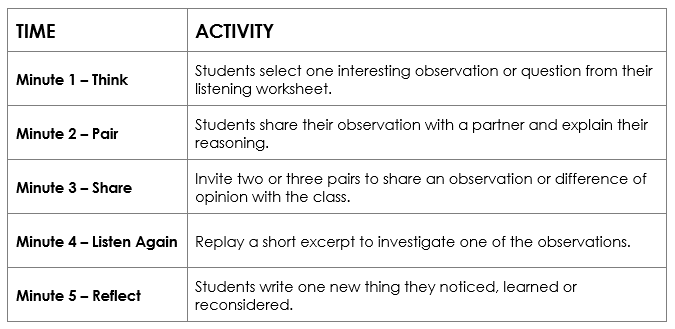
Teaching Tip: Keep the routine flexible. Focus on dynamics in one lesson, instrumentation in another or changes in musical texture when exploring a new piece.
The goal is to move beyond identifying musical elements to explaining what students hear and why.
With regular practice, this routine can help students become more confident discussing and analysing music.
Make the Most of Your Music Listening Worksheets
Music listening worksheets are more than a way for students to record answers. They can become the starting point for engaging classroom discussions and deeper musical understanding.
Simple strategies such as Think – Pair – Share, Music Detective challenges and short musical debates help middle school students move beyond identifying musical elements to explaining what they hear and why.
You don't need to use all ten strategies in one lesson. Start with one or two that suit your students and the music you're exploring.
With regular practice, students can become more confident expressing their opinions, using musical vocabulary and supporting their observations with evidence.
Remember: A completed music listening worksheet doesn't have to mark the end of the activity. It can be the beginning of a great musical conversation!
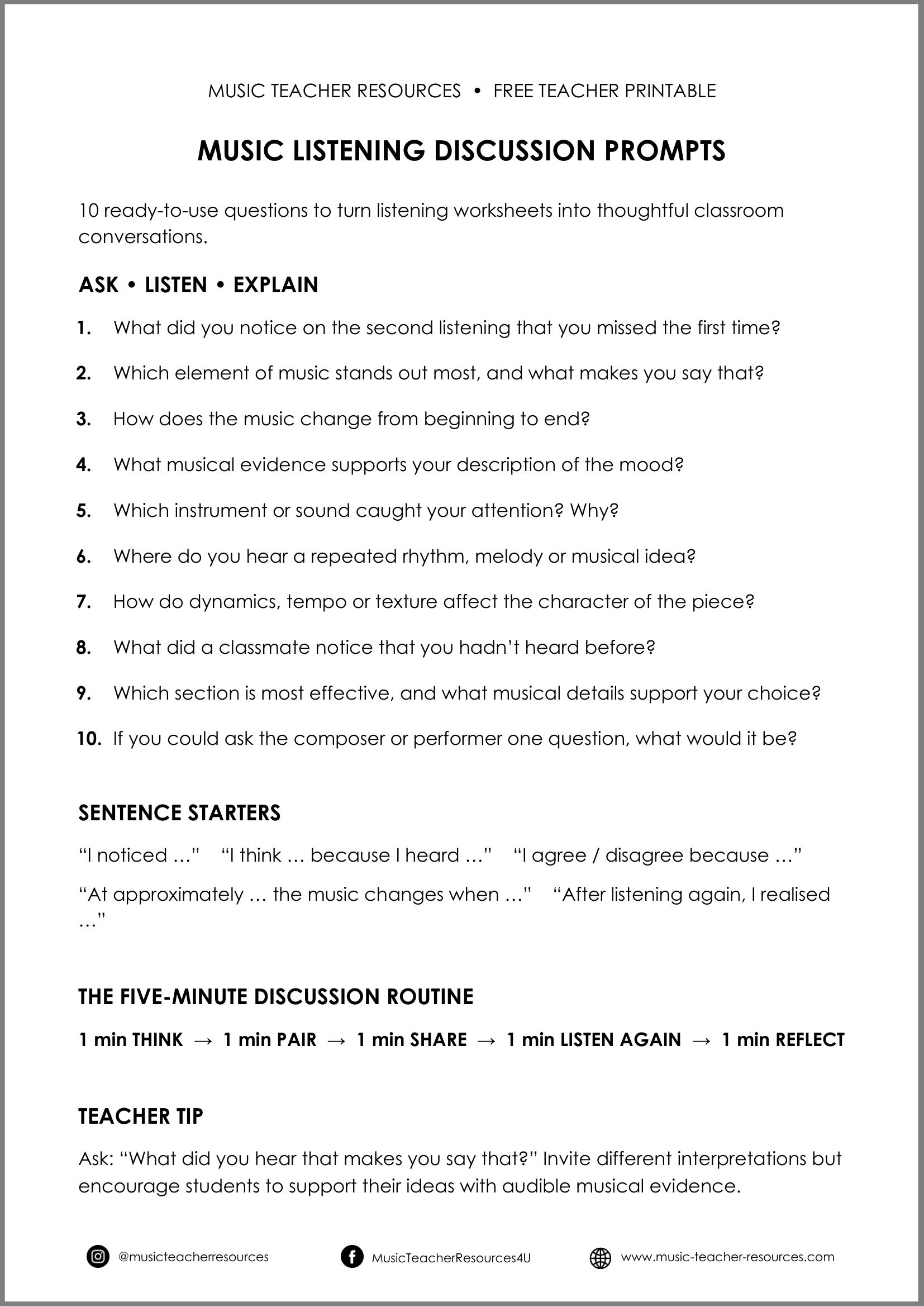
FREE Music Listening Discussion Prompts Printable
Ready to turn your music listening worksheets into engaging classroom discussions?
Download my FREE Music Listening Discussion Prompts printable — a one-page teacher reference sheet featuring:
-
10 ready-to-use discussion questions to encourage deeper musical listening.
-
Student sentence starters to help students explain their observations and opinions.
-
A simple five-minute discussion routine you can use with almost any music listening activity.
Perfect for middle school and junior high school music teachers looking for practical, low-prep ways to encourage active listening, develop musical vocabulary and build critical thinking skills.
DOWNLOAD YOUR FREE MUSIC LISTENING DISCUSSION PROMPTS
Print a copy for your teaching folder or keep it handy for your next music listening lesson!
Looking for questions to get students thinking? Explore 5 Music Listening Questions That Get Middle School Students Thinking for practical prompts that encourage students to listen carefully, identify musical elements and explain their responses using musical evidence.
Explore More Music Listening Activities
Looking for ready-to-use music listening worksheets to put these discussion strategies into practice?
At MusicTeacherResources, you'll find printable music listening and appreciation activities covering musical genres, famous compositions and the elements of music.
These resources provide a practical starting point for engaging listening lessons and meaningful classroom discussions.
Explore MusicTeacherResources Music Listening Activities and discover more ways to make music listening interactive and enjoyable!
Would you like more music teaching strategies? Check out these related posts to keep your lessons fresh and interactive!
Blog Post: Top Tips for Planning a Student Concert
Blog Post: Halloween Music Bingo: A Fun and Easy October Music Lesson
Blog Post: 8 Ways to Use Google Slides in the Music Classroom
Blog Post: 10 Fun and Effective Music Class Seating Plan Ideas

Sign up to receive the monthly MTR newsletter and gain exclusive access to the
FREE Resource Library for music teachers!
